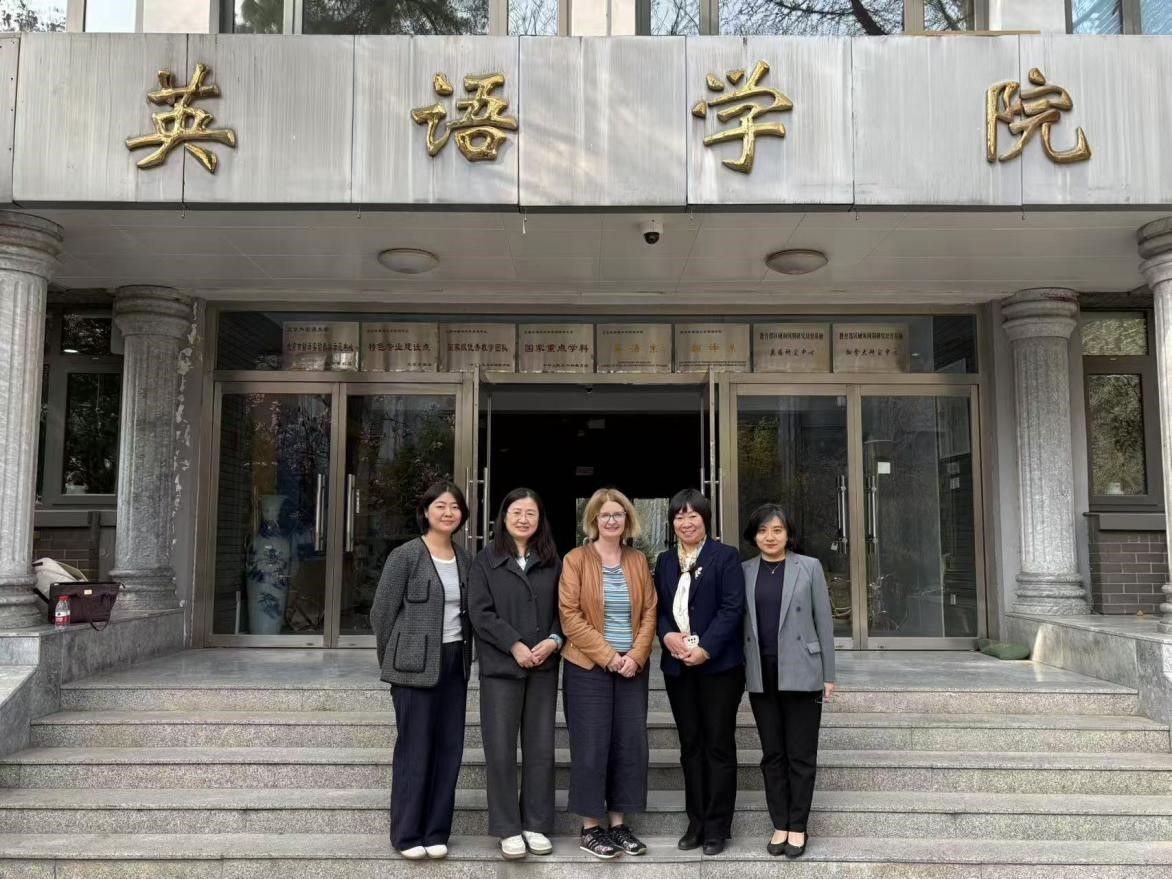
On the afternoon of March 26, Professor Sasha Calhoun—Head of the School of Linguistics and Applied Language Studies at New Zealand’s Victoria University of Wellington and a noted phonetician—visited the School of English and International Studies (SEIS) at Beijing Foreign Studies University. The visit centered on a public lecture, “Sound Symbolic Associations of Pitch: Social Variations and Their Implications.”
Ahead of the lecture, Professor Calhoun met in Room 111 with Dean Yang Luxin, Vice Dean Peng Ping, and Dou Wei, Director of SEIS’s Center for South Pacific Languages and Cultures. Dean Yang welcomed Professor Calhoun and outlined the School’s distinctive profile: a complete training pipeline from the undergraduate level through post-doctoral study; long-standing scholarly traditions in literature, linguistics, sociology and cultural studies, area studies, foreign-language education, and translation; and active partnerships with leading universities around the world.
Vice Dean Peng Ping briefed Professor Calhoun on the progress of a cooperative agreement between the two institutions, expressing the hope that the visit would help move planned faculty and student exchanges into action.
Professor Calhoun, in turn, shared examples of Victoria’s collaborations with universities in China and spoke warmly of her interest in BFSU students. She pledged to encourage both early-career scholars and senior researchers from her school to visit SEIS in the coming years, with the aim of deepening academic ties between the two institutions.
The conversation then turned to specifics: short- and long-term student exchanges, joint training and dual-degree programs, and avenues for closer collaboration in linguistics.
In the lecture that followed, Professor Calhoun drew on experimental data to show how listeners’ associations between pitch and social meaning shift across groups—and what those shifts reveal about the cultural logic carried by the suprasegmental features of speech. A model of laboratory linguistics at its most disciplined, the talk offered fresh perspectives for research and teaching in cognitive linguistics, sociolinguistics, and English-language education.
The visit broadened the scholarly horizons of SEIS faculty and students and laid a firm foundation for sustained academic exchange and deeper collaboration between the two universities.