BEIJING — Beijing Foreign Studies University (BFSU) welcomed H.E. Jonathan Austin, the New Zealand Ambassador to China, to campus on December 12 for high-level discussions aimed at deepening educational collaboration and fostering cross-cultural exchange.

The Ambassador was received by Li Hai, Secretary of the CPC BFSU Committee, for a meeting that underscored the university's strategic focus on South Pacific studies.

In his welcoming remarks, Li expressed gratitude for the New Zealand Embassy’s longstanding support of BFSU’s academic programs, particularly in the construction of South Pacific language curricula and the development of Māori language textbooks. Li highlighted the robust history of exchange between BFSU and New Zealand institutions and articulated a desire to expand the scope of this cooperation. He proposed diversifying collaborative fields and exploring innovative engagement models, such as the establishment of a "South Pacific Cultural Salon" to facilitate deeper academic dialogue.

Ambassador Austin spoke highly of BFSU’s distinctive achievements in teaching and preserving South Pacific languages and cultures, with a specific emphasis on the university's Māori language program. Noting the vast potential for educational cooperation between New Zealand and China, Austin affirmed the Embassy’s commitment to strengthening partnerships in areas including faculty and student mobility, joint research initiatives, and the further development of regional language disciplines.
Beyond traditional academic cooperation, the dialogue addressed the evolving landscape of higher education in the digital age. Both parties engaged in an in-depth exchange regarding the opportunities and challenges artificial intelligence presents to language pedagogy.
Discussions also centered on the pioneering "Chinese-English-Māori" trilingual advanced interpreter training program. This initiative, designed to cultivate high-level translation talent, represents a significant step in linguistic diplomacy, with specific attention given to the training of the program's first cohort of Māori students.
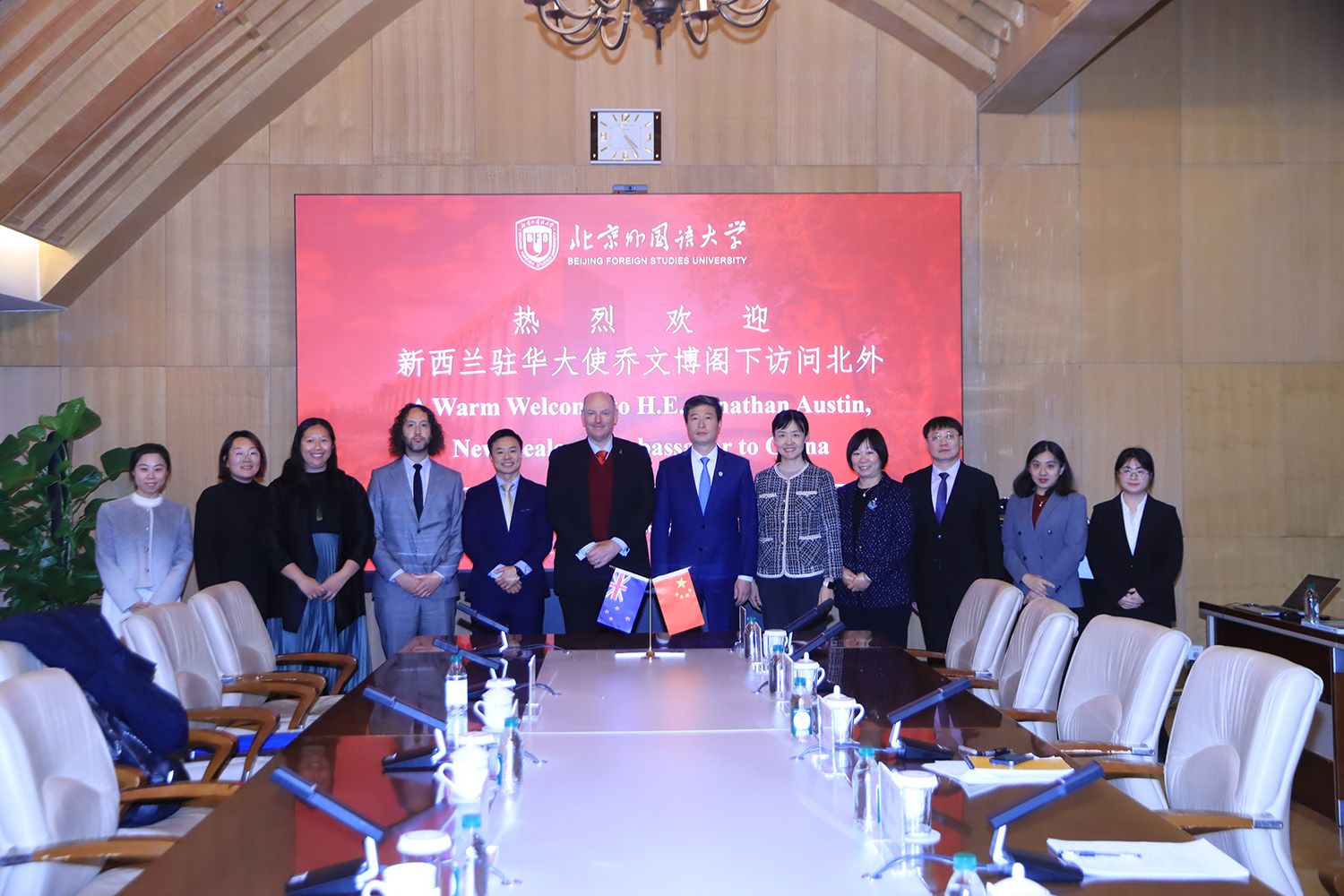
The meeting was attended by a delegation from the New Zealand Embassy, including Aramiro Tai Rākena, Counselor for Economy, Trade, and Environment; Education Counselor Ron Xavier; and Second Secretary Jennifer-Lee Prichard.
Representing BFSU were key faculty members and administrators, including He Jing, Director of the Office of International Exchange and Cooperation; Peng Ping, Vice Dean of the School of English and International Studies; Bai Liang, Vice Dean of the School of Chinese Language and Literature; Dou Wei, Director of the Center for South Pacific Island Studies at SEIS; and Li Jian, a lecturer in the Tongan language.